Types of Machine Learning
A simple guide to the main types of Machine Learning, including Supervised, Unsupervised, Reinforcement, Semi-Supervised, and Self-Supervised Learning, with their common algorithms and use cases.
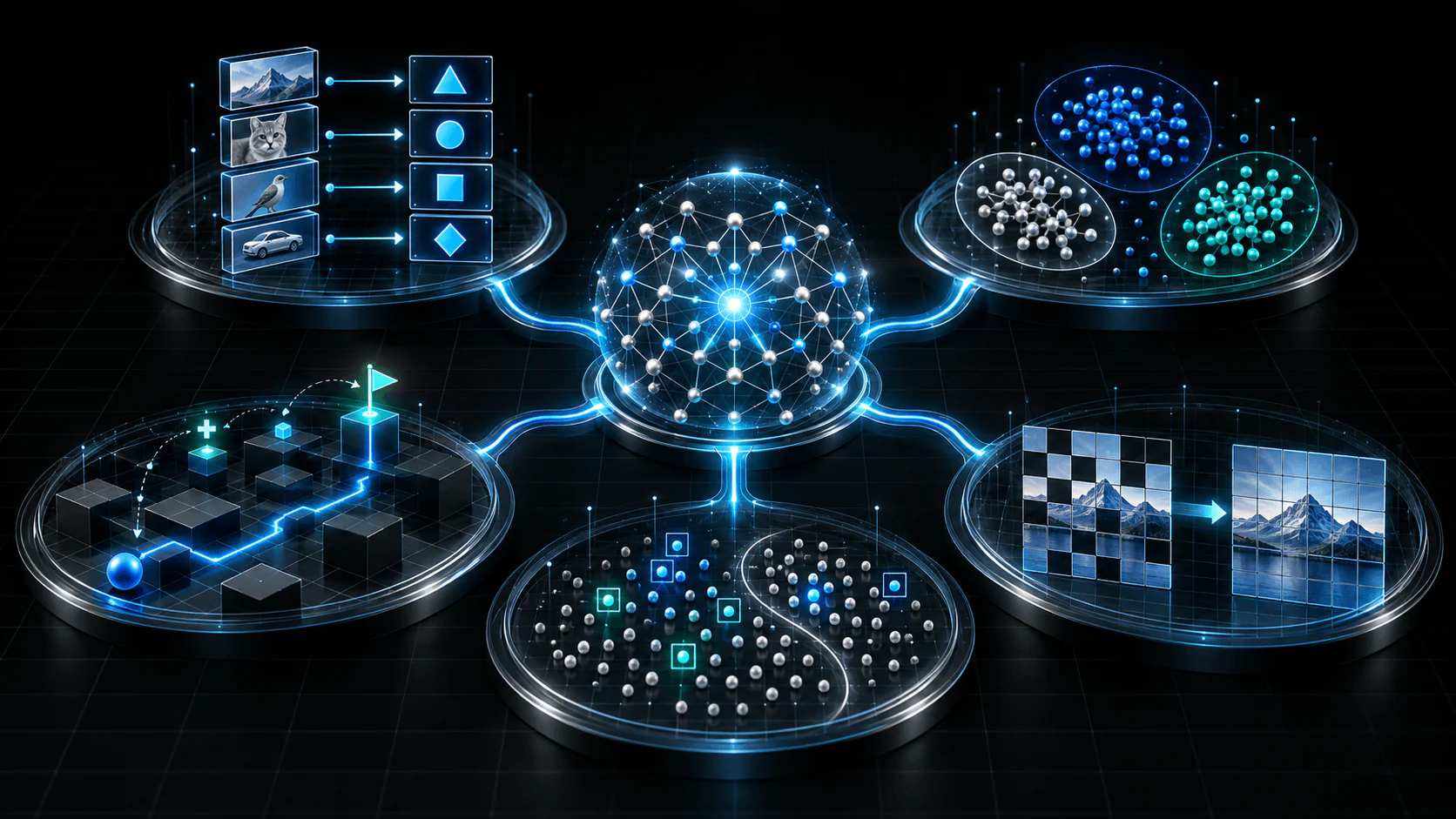
In Part Two of the Machine Learning series, we discussed data types, data processing, and embeddings. However, there is one very important topic that we have not discussed yet: the different types of Machine Learning.
Machine Learning has several well-known and widely used types, including:
- Supervised Learning
- Unsupervised Learning
- Reinforcement Learning
There are also other types, such as:
- Semi-Supervised Learning
- Self-Supervised Learning
Let’s take them one by one, break them down, and discuss each type in detail.
1. Supervised Learning
Supervised Learning depends on Labeled Data. This means that we have Features, which are the Inputs, and a Target, which is what we want to predict.
Supervised Learning learns from both of them together to understand the relationship between them.
There are two main parts of Supervised Learning:
- Regression
- Classification
Regression
Regression is used to predict a numerical value. For example, we may want to predict the price of a house or predict something for the next month.
Some algorithms used for Regression include:
- Linear Regression
- Polynomial Regression
- Ridge and Lasso Regression
- Decision Tree Regression
- Random Forest Regression
Classification
Classification is used to predict a specific category. It includes two types:
- Binary Class: This predicts only two classes, such as male or female.
- Multi-Class: This predicts more than two classes, such as red, green, or blue.
Some algorithms used for Classification include:
- Logistic Regression
- Support Vector Machines (SVM)
- Random Forest Classification
- K-Nearest Neighbors (KNN)
- Naive Bayes
2. Unsupervised Learning
Unsupervised Learning depends on Unlabeled Data. This means that the data contains Features, which are the Inputs, but it does not contain a Target, which is what we normally use for prediction.
Unsupervised Learning includes several parts:
- Clustering
- Dimensionality Reduction
Clustering
The goal of Clustering is to group similar categories together.
Some algorithms used for Clustering include:
- K-Means
- Hierarchical Clustering
- DBSCAN
Dimensionality Reduction
The goal of Dimensionality Reduction is to simplify the data and reduce a large number of columns into a smaller number of columns while preserving the importance of the information.
It also helps speed up the Training process.
Some algorithms used for Dimensionality Reduction include:
- PCA (Principal Component Analysis)
- t-SNE
3. Reinforcement Learning
Reinforcement Learning is different because we do not directly give it data to learn from.
Instead, we place it inside an environment and define a goal for it. Whenever it makes a correct decision, it receives a Reward. If it makes a wrong decision, it receives a punishment or Penalty.
Over time, it learns how to make the decisions that give it a Reward.
4. Semi-Supervised Learning
Semi-Supervised Learning solves a very important problem: Labeled Data is usually limited and expensive, while Unlabeled Data is much more available.
For example, imagine that a student studies three pages very well. The student then moves on to 500 pages and learns from them and from their mistakes, depending on the simple rules they learned from the first three pages.
5. Self-Supervised Learning
In Self-Supervised Learning, we have Unlabeled Data, and we do not have any human-provided model answers.
Instead of giving up, the system creates its own answers and starts learning from them.
Written by
Mohamed Alawakey
ML & AI Engineer documenting practical decisions from building RAG, LLM, machine-learning, and FastAPI systems.